Monetization project | Apollo 247
Lets know what is 'Apollo 247'
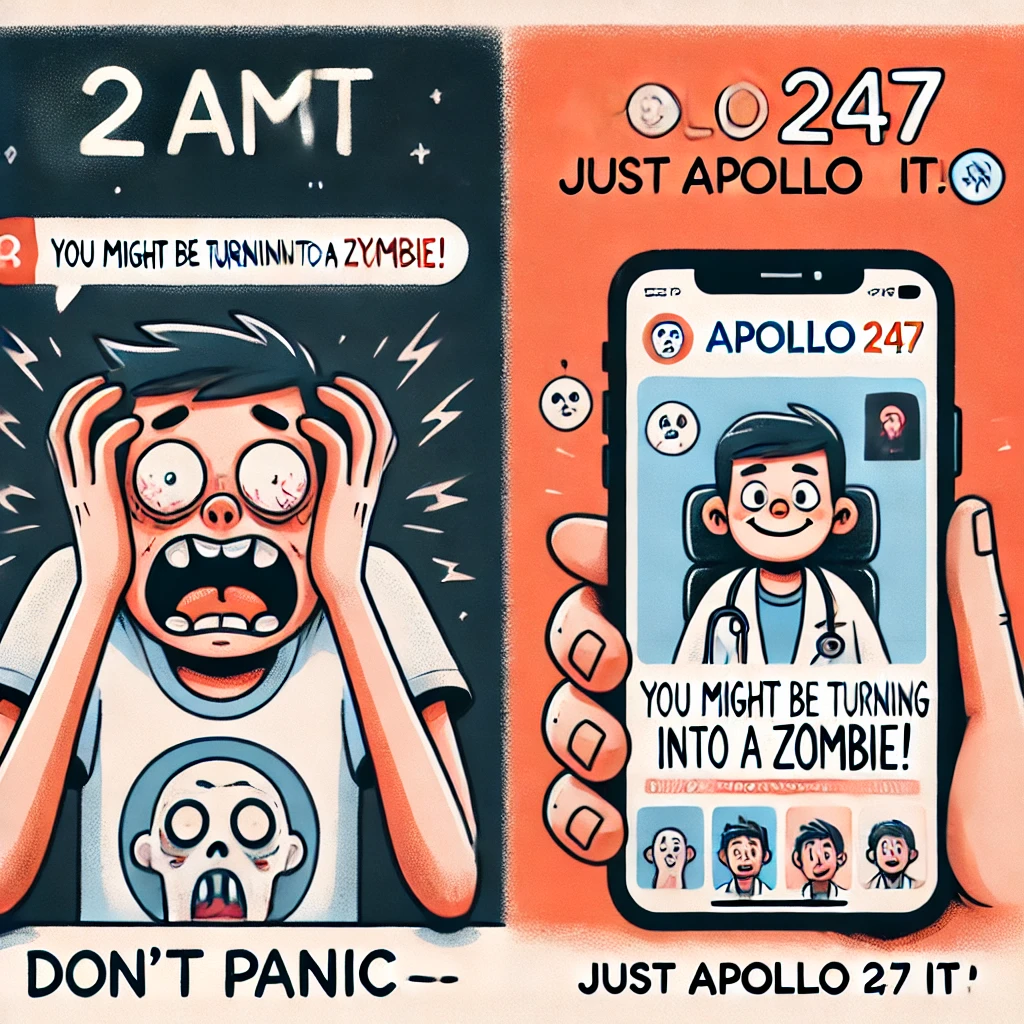
Apollo 247: Your 24/7 Health Superhero in Disguise! 🦸♂️💊
Imagine this: It’s 2 AM, and your throat suddenly feels like you swallowed a cactus. 🌵
You panic—should you wait till morning? Google your symptoms and convince yourself it's something dramatic? Nope. You whip out your phone, open Apollo 247, and boom --> expert doctors, medicines, and even lab tests are at your fingertips.
Yes, Apollo 247 is the Iron Man suit of healthcare i.e., powerful, sleek, and packed with everything you need. 🦾
So, what’s the big deal? What makes Apollo 247 special?
- Apollo Expertise, Now in Your Pocket 📲
Backed by Apollo Hospitals’ 40+ years of medical excellence, Apollo 247 isn’t just another health app—it’s a powerhouse of trusted healthcare. Unlike other platforms that feel like a collection of random doctors, Apollo 247 gives you access to Apollo-certified specialists who know their stuff. - Doctor Consultations: Anytime, Anywhere! 🏥💻
No more waiting in long hospital queues (or awkwardly explaining your symptoms in a crowded waiting room). With Apollo 247, you get instant video consultations with top doctors across 20+ specialties. - Medicines Delivered Fast! 🚀💊
If you think food delivery is fast, wait till you try Apollo 247’s super-speedy medicine delivery. Need something urgently? 2-hour delivery in select cities. Need refills? One-tap reordering saves you the headache. - Lab Tests Without the Hassle 🧪
Forget waking up early to rush to a lab. Apollo 247 offers at-home sample collection—so you can get tested while still in your pajamas. Plus, discounts on tests because good health shouldn’t burn a hole in your wallet! - AI-Powered Symptom Checker 🤖
Before you spiral into a self-diagnosing nightmare on Google, Apollo 247’s AI-driven symptom checker gives you a reliable health assessment and suggests the right doctor to consult. - 24/7 Health Assistance 🌙✨
Unlike some apps that clock out at 9 PM, Apollo 247 is always awake (probably had too much coffee ☕). Late-night fever? Midnight headache? No worries, Apollo 247 has your back 24/7. - Apollo Circle Membership: VIP Treatment for Your Health! 👑
Want exclusive discounts, free doctor consultations, and priority service? Enter Apollo Circle, a membership that turns you into the VIP of healthcare.
But Wait... How is Apollo 247 Better Than Others? 🤔
- Trust Factor: It’s from Apollo Hospitals, one of India’s most respected healthcare brands. Not just a random startup!
- Specialist Access: You don’t just get any doctor; you get Apollo-certified experts.
- Speed Matters: 2-hour medicine delivery (faster than your pizza 🍕) and instant consultations.
- AI + Human Touch: The symptom checker helps, but real doctors make the final call.
- No More Confusion: Everything i.e., consultations, tests, medicines all in one place. No need to juggle multiple apps.
Lets move on to Ideal Customer Profiles for Apollo 24|7
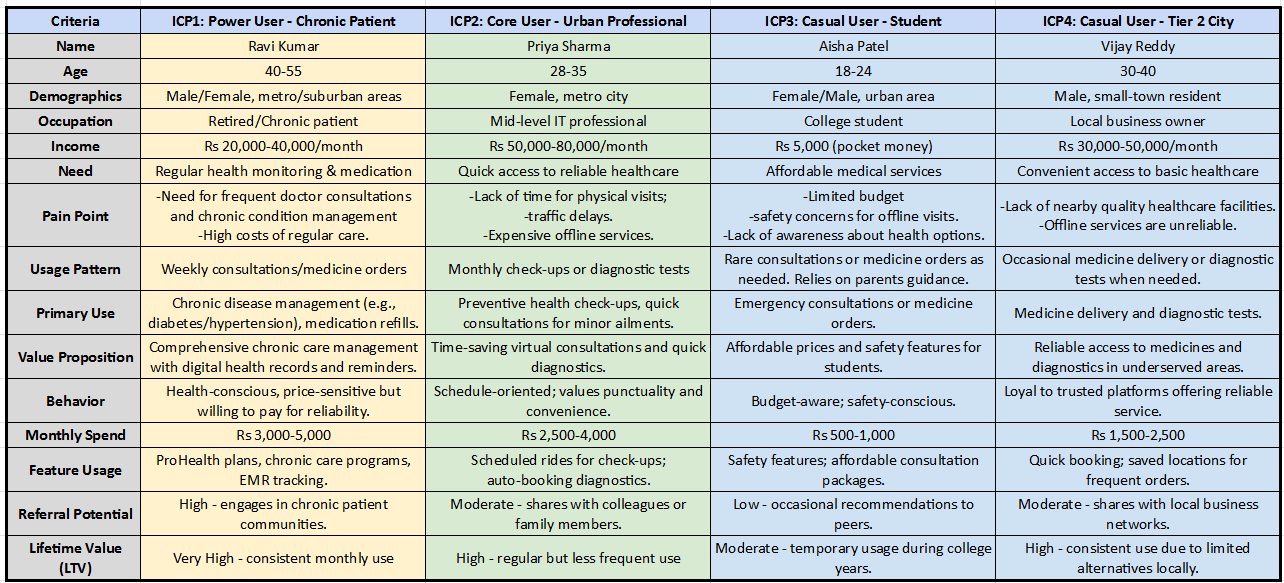
Lets breakdown of each ICP for Apollo 24|7, focusing on essential details for monetization:
ICP1: Power User – Chronic Patient
- Key Traits: Aged 40-55, requires frequent consultations and medication refills for chronic conditions like diabetes or hypertension.
- Monetization Potential: High lifetime value due to consistent monthly spending (₹3,000-5,000). Ideal for chronic care programs, subscription plans, and EMR-based services.
- Why They Choose Apollo: Comprehensive chronic care management, digital health records, and reliable medicine delivery.
- Alternatives: Medibuddy (less integrated chronic care focus).
- Recency: Weekly interactions (consultations/medicine orders).
- Frequency: High – multiple transactions per month.
- Monetary: High – spends ₹3K-5K/month on chronic care services.
ICP2: Core User – Urban Professional
- Key Traits: Aged 28-35, time-sensitive with a focus on preventive health check-ups and quick consultations for minor ailments.
- Monetization Potential: High recurring revenue through diagnostics and teleconsultation services (₹2,500-4,000/month).
- Why They Choose Apollo: Time-saving virtual consultations and seamless diagnostic services.
- Alternatives: Practo (limited integration with offline healthcare).
- Recency: Monthly interactions (check-ups or diagnostics).
- Frequency: Moderate – 1-2 transactions per month.
- Monetary: Medium – spends ₹2.5K-4K/month.
ICP3: Casual User – Student
- Key Traits: Aged 18-24, budget-conscious and uses healthcare services occasionally for emergencies or minor ailments.
- Monetization Potential: Low to moderate due to infrequent usage (₹500-1,000/month). Can be upsold affordable consultation packages or promotional offers.
- Why They Choose Apollo: Affordable pricing and safety features.
- Alternatives: DocsApp or local clinics.
- Recency: Infrequent interactions (emergency-based).
- Frequency: Low – occasional transactions when needed.
- Monetary: Low – spends ₹500-1K/month.
ICP4: Casual User – Tier 2 City
- Key Traits: Aged 30-40, relies on Apollo for access to quality healthcare in underserved areas.
- Monetization Potential: Moderate to high (₹1,500-2,500/month). Focus on medicine delivery and diagnostics in regions with limited competition.
- Why They Choose Apollo: Reliable access to medicines and diagnostics where alternatives are scarce.
- Alternatives: Local pharmacies or government hospitals.
- Recency: Occasional interactions (medicine delivery/diagnostics).
- Frequency: Low to moderate – 1 transaction every few weeks.
- Monetary: Medium – spends ₹1.5K-2.5K/month.
These ICPs highlight opportunities to tailor monetization strategies like subscription plans, loyalty programs, or targeted promotions based on user needs and spending patterns.
Monetization litmus test
(Conduct the litmus test for Apollo 24|7)
Retention Graph
- As per industry data, e-pharmacies have a retention rate of 72% in urban areas and 77% in tier 2 & tier 3 cities.
- Of the user base in Apollo 247, many are Circle members who have shown their commitment to the app by purchasing a membership. The retention of such users is for a longer time.
- Using the above facts, Apollo 247 can be said to have a retention rate of about 54%.

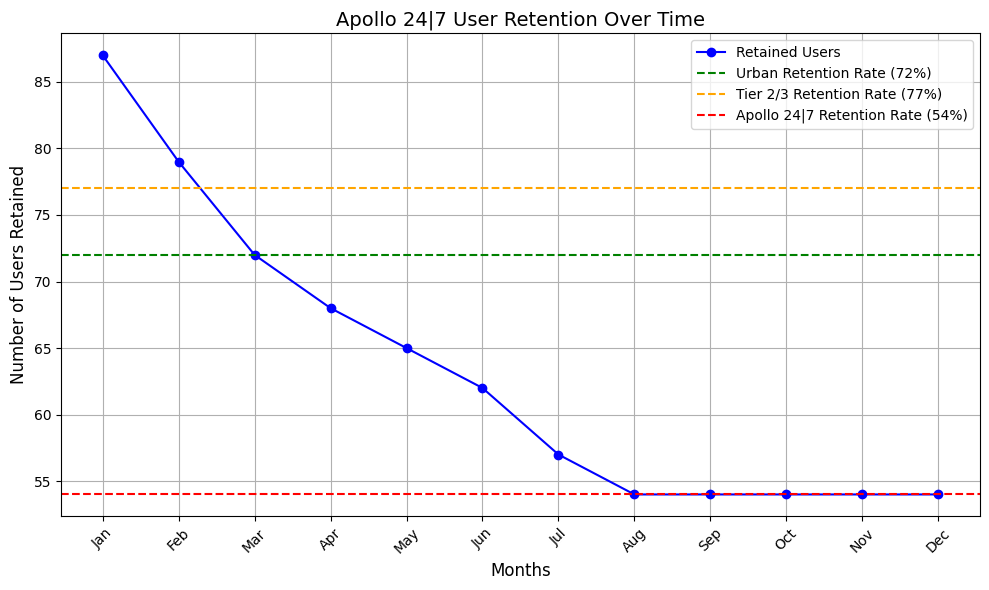
The graph illustrates the retention of Apollo 24|7 users over a 12-month period (January to December). It also compares Apollo's retention rate (54%) with industry benchmarks for e-pharmacies in urban areas (72%) and Tier 2/3 cities (77%).
Lets see at User data in the Graph with respect to month
- High Retention Segment (Jan–Mar):
- Users retained in the first three months are likely Circle Members or chronic patients who rely on Apollo for regular consultations, medicines, or diagnostics.
- These users exhibit high engagement and loyalty, contributing significantly to revenue.
- Moderate Retention Segment (Apr–Jul):
- Users retained during this period may include urban professionals or casual users who use the platform occasionally for preventive care or emergencies.
- Retention begins to decline as these users might explore alternatives or reduce healthcare spending.
- Low Retention Segment (Aug–Dec):
- By August, retention stabilizes at 54%. This segment likely consists of highly loyal users who continue using Apollo for convenience or lack of alternatives in Tier 2/3 cities.
Insights
- Retention Challenges:
- Apollo's overall retention rate (54%) is lower than industry benchmarks for urban areas (72%) and Tier 2/3 cities (77%). This indicates a need for stronger engagement strategies, especially for casual users.
- Opportunities with Circle Members:
- Circle Members demonstrate higher retention due to their commitment through memberships. Expanding this program with added benefits could boost long-term retention.
- Tier 2/3 Cities as a Growth Area:
- Retention rates in Tier 2/3 cities are generally higher across the industry. Apollo can capitalize on this by enhancing accessibility and offering localized services.
- Monetization Focus:
- High-retention users (chronic patients and Circle Members) should be targeted with subscription plans and personalized health programs.
- Moderate-retention users can be incentivized with discounts, loyalty rewards, or bundled services to increase engagement.
- Alternative Solutions:
- Competitors like Practo and Medibuddy may attract casual users due to their broader service offerings or price competitiveness. Differentiating through superior service quality and convenience will be key.
By addressing retention gaps and focusing on high-value segments, Apollo 24|7 can enhance user loyalty and drive monetization effectively.
Depth of Engagement
Lets revisit the ICPs and adding specific nuances that will be helpful to us.
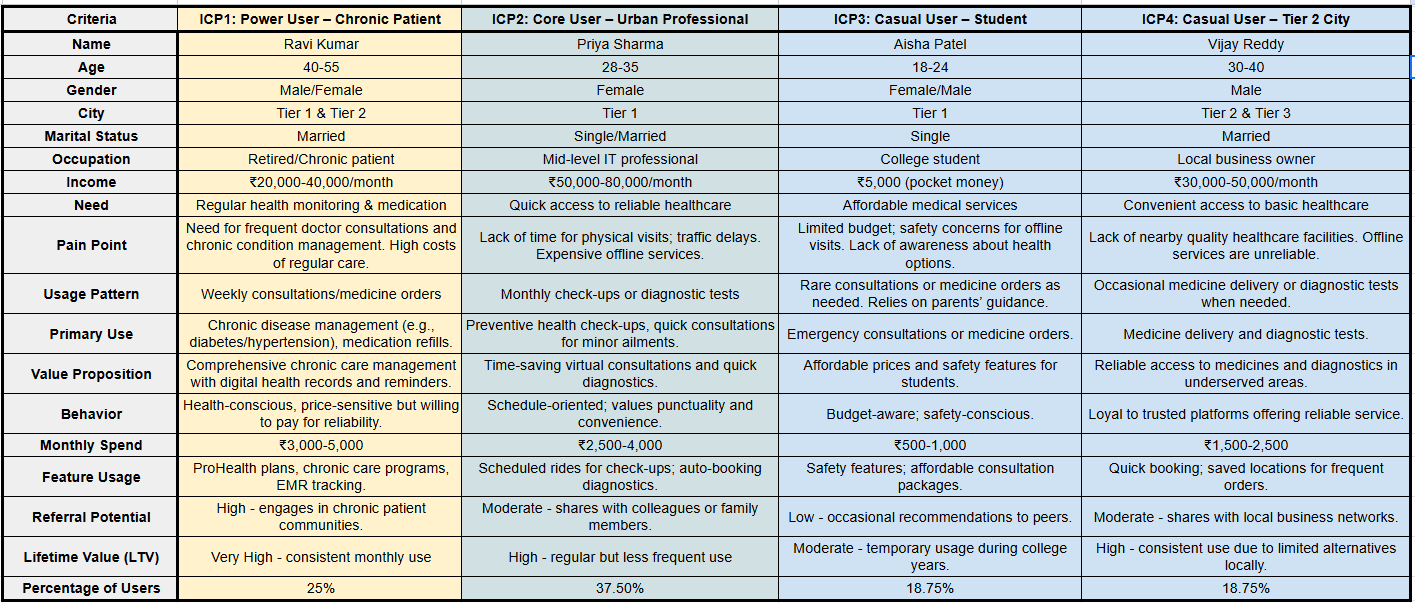
From user calls of 9 users, 2 were power users, 4 were core users and 3 were casual users.
From this data, more than 50% of users are in the core & power user segment.
From the ICPs, lets summarize as per user segments and its engagement:
Power Users (25%)
- These users are chronic patients who rely on Apollo for recurring medication and health monitoring.
- They contribute significantly to revenue due to their high monthly spend (₹3K–5K) and consistent usage.
- Monetization Strategy: Focus on subscription models like Circle Memberships with added benefits such as free delivery or discounts on chronic care programs.
Core Users (37.5%)
- Urban professionals who value convenience and time efficiency.
- They purchase not just medicines but also supplements and personal hygiene products regularly.
- Monetization Strategy: Promote bundled offerings (e.g., medicines + wellness products) and loyalty rewards to encourage higher frequency purchases.
Casual Users – Students (18.75%)
- Students are budget-conscious and use Apollo occasionally for emergencies or minor ailments.
- Monetization Strategy: Offer affordable consultation packages and discounts targeted at younger demographics.
Casual Users – Tier 2 Cities (18.75%)
- These users rely on Apollo due to limited local healthcare options.
- Their spending is moderate but consistent due to a lack of alternatives.
- Monetization Strategy: Expand localized services like faster delivery times or regional language support.
Willingness to Pay
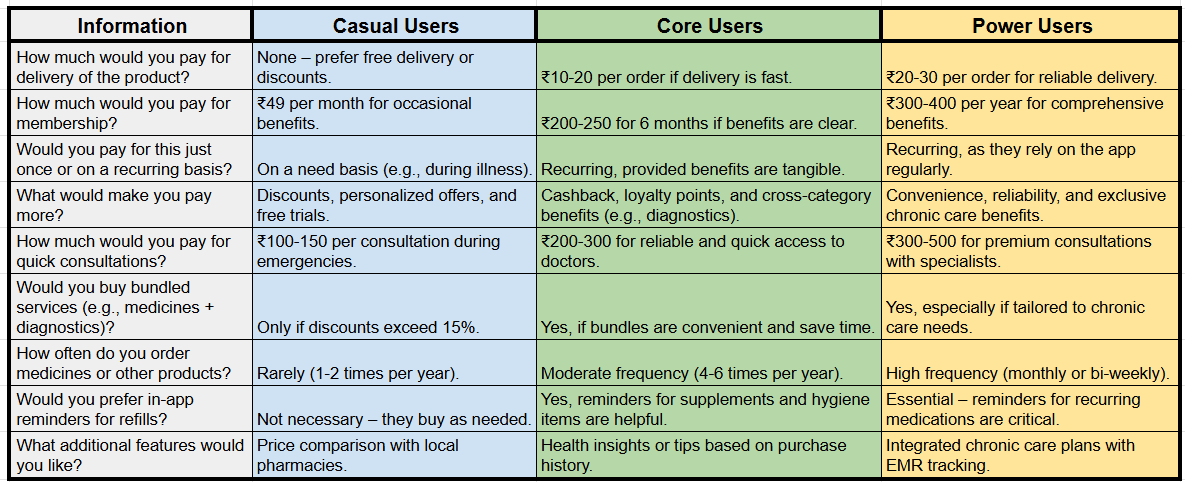
Insights from the Questions
- Willingness to Pay
- Casual Users: Price-sensitive; prefer free delivery and low-cost memberships.
- Core Users: Willing to pay moderate amounts if they see tangible benefits like cashback or loyalty rewards.
- Power Users: Open to higher payments due to their reliance on Apollo 24|7 for chronic care management.
- Engagement
- Casual Users engage sporadically during emergencies or illnesses.
- Core Users engage moderately with a focus on convenience and preventive care.
- Power Users engage frequently due to recurring health needs.
- Value Perception
- Casual Users value discounts and affordability over features.
- Core Users value convenience, cross-category benefits, and time-saving features.
- Power Users prioritize reliability, chronic care programs, and personalized services.
- Monetization Opportunities
- Introduce tiered membership plans catering to different user segments.
- Offer bundled services with discounts tailored to Core and Power Users.
- Provide personalized offers or free trials to convert Casual Users into recurring customers.
This segmentation allows Apollo 24|7 to optimize pricing strategies, enhance user engagement, and drive monetization effectively across all user types.
Summary
Apollo 247 cleared the litmus test and is ready for next steps of Monetization.
We have done the Litmus test to give an overview, how conditions are met to proceed for Monetization stage for Apollo 247.
Apollo 24|7 is already in the monetization stage.
The platform generates revenue through multiple streams, as evidenced by its offerings and user segmentation insights. Here's how Apollo 247 is monetizing:
Key Monetization Strategies Used by Apollo 24|7
- Membership Plans
- Paid memberships like Circle Membership are a significant revenue driver.
- Users, especially Core (37.5%) and Power Users (25%), are willing to pay Rs 200-300 for membership plans due to tangible benefits like free delivery, discounts, and priority consultations.
- Medicine Delivery
- Medicine delivery is a core revenue stream, with Power Users frequently ordering recurring medications and Core Users buying supplements and hygiene products regularly.
- Delivery fees are accepted by Core (₹10-20/order) and Power Users (₹20-30/order), adding incremental revenue.
- Diagnostics & Teleconsultations
- Diagnostics and teleconsultations are popular among Core and Power Users, with willingness to pay ranging from ₹200-500 per consultation.
- These services cater to the preventive care needs of Core Users and chronic care management for Power Users.
- Cross-Selling & Bundled Services
- Bundled offerings (e.g., medicines + diagnostics) appeal to Core and Power Users, increasing average order value.
- Casual Users (18.75%) can be converted into repeat buyers through targeted promotions or discounts on bundled services.
Insights from User Segments
- Power Users (25%)
- High LTV due to consistent monthly spending (₹3K–5K) on medicines and chronic care programs.
- Monetization focus: Expand chronic care plans with added benefits like free consultations or exclusive discounts.
- Core Users (37.5%)
- Significant contributors with moderate frequency purchases of medicines, supplements, and diagnostics.
- Monetization focus: Promote loyalty programs, cashback offers, and convenience-driven bundles.
- Casual Users – Students (18.75%)
- Low-frequency users who engage during emergencies or illnesses.
- Monetization focus: Affordable consultation packages and discounts to encourage app engagement.
- Casual Users – Tier 2 Cities (18.75%)
- Moderate-frequency users relying on Apollo for accessibility in underserved areas.
- Monetization focus: Localized services like faster delivery times or regional language support.
Retention & Revenue Growth
- Retention stabilizes at 54%, driven by Power Users and Circle Members who demonstrate loyalty.
- Apollo 24|7's retention rate is slightly below the industry benchmarks for e-pharmacies in urban areas (72%) and Tier 2/3 cities (77%), indicating room for improvement through enhanced user engagement strategies.
Conclusion
- Apollo 24|7 has established itself as a monetized platform by leveraging its diverse user base, offering tailored services, and capitalizing on its strong brand presence under Apollo Hospitals.
- IMPROVEMENT EXPECTED : The focus now should be on improving retention rates, expanding membership benefits, and increasing engagement among Casual Users to maximize revenue potential further.
Now since we already know the Monetization strategies already used and what are the improvement needed, lets create 3 Experiments for free to paid conversion and cross-selling and up-selling.
Experiment 1: Freemium Model with Milestones for Free-to-Paid Conversion
Objective: Convert free users into paid Circle Members by showcasing the value of premium features.
Implementation Steps:
- Freemium Offer:
- Provide free access to basic features like medicine delivery tracking, basic consultations, and health tips.
- Lock premium features such as free delivery, priority consultations, discounts on diagnostics, and chronic care plans behind a membership paywall.
- Journey with Milestones:
- Set milestones for users (e.g., after 3 purchases or 2 consultations) to prompt them to explore premium features.
- Use in-app notifications like: "Unlock free delivery and save ₹300 this month with Circle Membership!"
- Limited-Time Offers:
- Offer a 7-day free trial of Circle Membership to showcase benefits.
- Post-trial, send email campaigns highlighting savings and exclusive benefits.
- Targeted Campaigns:
- Use AI to identify frequent users (Core and Power Users) who are more likely to convert.
- Send personalized emails with subject lines like: "Priya, save ₹500 on your next order with Circle Membership!"
Success Metrics:
- Conversion rate from free to paid membership.
- Retention rate of new paid members after the trial period.
Experiment 2: Cross-Selling Through Bundles
Objective: Increase AOV by bundling complementary products based on user behavior.
Implementation Steps:
- AI-Driven Recommendations:
- Use AI to analyze purchase patterns and suggest bundles. For example:
- If a user buys multivitamins, suggest a bundle with immunity boosters or protein powder.
- If a user buys sunscreen, recommend a skincare bundle with moisturizer or serum.
- Bundle Discounts:
- Offer discounts on bundled products (e.g., "Buy sunscreen + serum together and save 15%!").
- In-App Prompts:
- Display bundles during checkout with messages like: "Customers who bought this also purchased..."
- Personalized Email Campaigns:
- Highlight relevant bundles based on past purchases (e.g., "Complete your skincare routine with our exclusive bundle!").
Success Metrics:
- Increase in AOV per transaction.
- Click-through rate (CTR) on bundle recommendations.
Experiment 3: Up-Selling Chronic Care Plans
Objective: Encourage Power Users to upgrade from recurring medicine orders to comprehensive chronic care plans.
Implementation Steps:
- Highlight Value of Chronic Care Plans:
- Use in-app banners like: "Save up to ₹2,000/year with our Chronic Care Plan – includes free delivery and priority consultations!"
- Personalized Offers for Power Users:
- Identify users who order medicines monthly and send targeted offers via email or SMS (e.g., "Ravi, simplify your health management – subscribe to our Chronic Care Plan today!").
- Exclusive Benefits for Subscribers:
- Include perks like free EMR tracking, priority access to specialists, and additional discounts on diagnostics for chronic care subscribers.
- Gamify the Experience:
- Reward milestones like completing a subscription or renewing membership with cashback or loyalty points.
Success Metrics:
- Subscription rate for chronic care plans among Power Users.
- Reduction in churn rate for chronic care subscribers.

Lets first understand what is Apollo 247's CVP:
Core Value Proposition
Apollo 24|7 provides accessible healthcare through digital solutions like medicine delivery, diagnostics, teleconsultations, and chronic care management.
What are your customers paying for?
- Casual Users:
- Pay for occasional medicine delivery or emergency consultations.
- Value affordability and convenience but are price-sensitive.
- Example: ₹49/month for free delivery or ₹100-150 per consultation during emergencies.
- Core Users:
- Pay for frequent medicine orders, supplements, and diagnostics.
- Value time-saving features like doorstep delivery and virtual consultations.
- Example: ₹200-250 for a 6-month membership offering discounts and free delivery.
- Power Users:
- Pay for recurring medication needs, chronic care plans, and premium features like EMR tracking.
- Value reliability, comprehensive care, and convenience.
- Example: ₹300-400/year for Circle Membership with chronic care benefits.
How does your product stand out?
- Convenience and Accessibility
- For Core and Casual Users:
- Time-saving features like virtual consultations and doorstep medicine delivery.
- Reliable access to healthcare services, especially in Tier 2 & Tier 3 cities where offline options are limited.
- For Power Users:
- Chronic care management programs with reminders for recurring medications and EMR tracking.
- Affordability
- Affordable pricing for consultations, medicines, and diagnostics, making healthcare accessible to budget-conscious users like students and Tier 2/3 city residents.
- Membership plans (e.g., Circle Membership) that offer discounts, free delivery, and cashback benefits.
- Comprehensive Healthcare Ecosystem
- Integration of medicine delivery, diagnostics, teleconsultations, and wellness products under one platform.
- Bundled services that cater to preventive care (e.g., health check-ups) and chronic disease management.
- Personalization
- AI-driven recommendations for cross-selling/up-selling products based on user behavior (e.g., bundling supplements with medicines).
- Targeted offers and reminders tailored to user segments (e.g., chronic patients or occasional buyers).
- Trust and Reliability
- Backed by Apollo Hospitals' legacy of quality healthcare services.
- High retention rates among loyal users due to consistent service delivery.
In Nutshell,
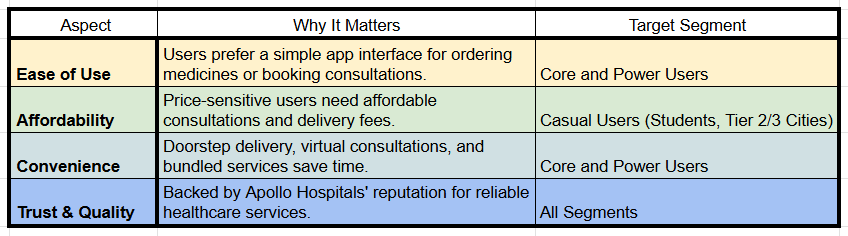
How do you position your product?
Apollo 24|7 differentiates itself from competitors by offering:
- Comprehensive Healthcare Ecosystem:
- Combines medicine delivery, diagnostics, teleconsultations, and chronic care management on a single platform.
- Substitutes like Practo or Medibuddy may excel in one area but lack this integration.
- Membership Benefits (Circle Membership):
- Offers free delivery, discounts on medicines/diagnostics, and priority consultations.
- Substitutes like Netmeds or Pharmaeasy offer discounts but lack integrated premium memberships.
- Accessibility in Tier 2/3 Cities:
- Reliable service in underserved areas where alternatives are limited to local pharmacies or clinics.
- AI-Driven Personalization:
- Tailored recommendations for cross-selling/up-selling (e.g., bundling supplements with medicines).
Pricing Comparison with Substitutes
Here’s a comparison of Apollo 24|7 with substitutes across key factors:
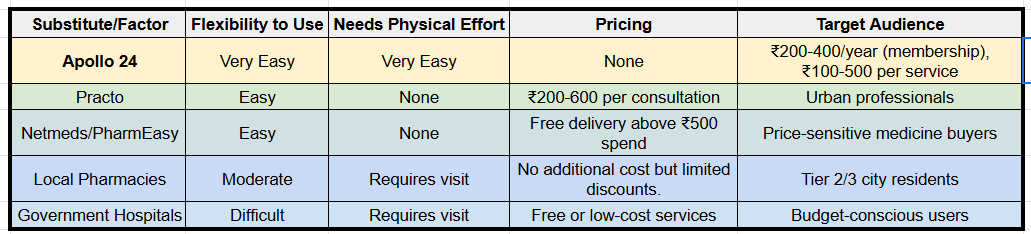
How Should Apollo Position Its Product?
- Highlight Comprehensive Care:
- Emphasize that Apollo 24|7 is a one-stop solution for medicines, diagnostics, consultations, and chronic care.
- Tagline idea: "Your Health Partner – Anytime, Anywhere."
- Premium Pricing for Convenience:
- Charge a premium for features like doorstep delivery, priority consultations, and bundled services.
- Example: Offer chronic care plans starting at ₹300/year with free delivery and EMR tracking.
- Focus on Trust & Accessibility:
- Leverage Apollo Hospitals’ reputation to attract users seeking quality healthcare.
- Highlight accessibility in Tier 2/3 cities where substitutes are limited.
- Targeted Campaigns by Segment:
- Casual Users: Offer low-cost trials (e.g., ₹49/month) to convert them into paid members.
- Core Users: Promote bundled services (e.g., medicines + diagnostics) with discounts.
- Power Users: Upsell chronic care plans with exclusive benefits like free consultations.
Factors to Consider Before Setting Pricing
- User willingness to pay based on perceived value (e.g., convenience vs affordability).
- Competitor pricing strategies (e.g., Prato's consultation fees or Netmed's discounts).
- Regional differences in user behavior (urban vs Tier 2/3 cities).
By focusing on its strengths—comprehensive care, convenience, trustworthiness—and aligning pricing with user needs, Apollo 24|7 can effectively position itself as the go-to digital healthcare platform while maximizing monetization opportunities.
Step 1: Baseline Scenario for Apollo 24|7
Let’s assume Apollo 24|7 currently has 10,000 non-revenue-generating users (free users). After introducing pricing, 40% of these users convert to paid plans at an average price of ₹300/month. This results in:
- Baseline Revenue:
₹300 x 4,000 users = ₹12,00,000/month
₹12,00,000 x 12 months = ₹1.44 crore/year
This baseline revenue serves as the starting point for measuring the impact of pricing on different user segments.
Step 2: Test Price Elasticity Across User Segments
We segment Apollo 24|7 users into Casual, Core, and Power Users based on their behavior. Using RFM analysis, we evaluate their recency (R), frequency (F), and monetary (M) potential and introduce pricing to measure churn and revenue gain.
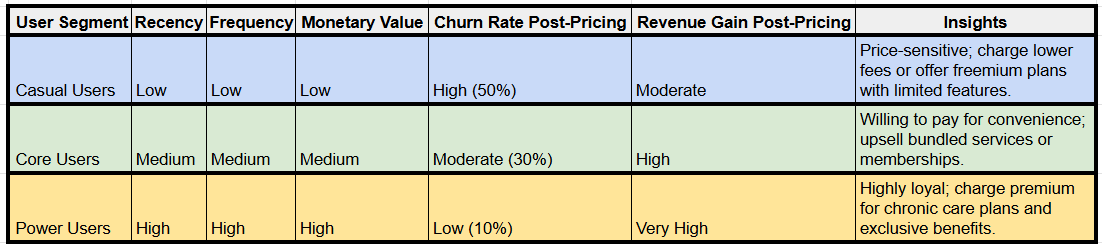
Based on the RFM analysis, if we plot the users across recency and frequency dimensions to identify key segments:
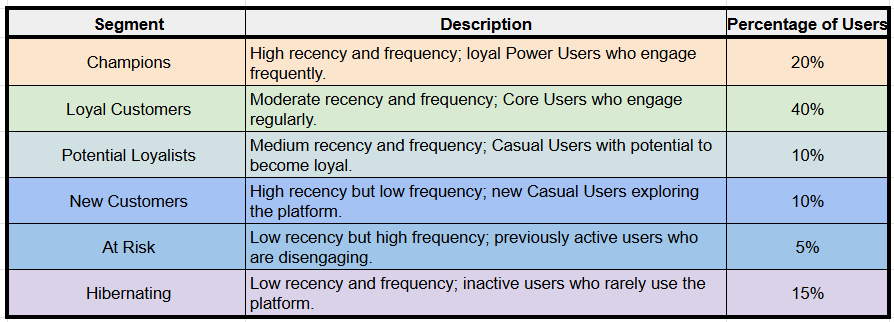
RFM Segmentation Chart insights
- Champions (Power Users):
- Highest recency and frequency scores.
- Contribute significantly to revenue with low churn rates.
- Ideal for premium pricing strategies.
- Loyal Customers (Core Users):
- Moderate recency and frequency scores.
- Open to paying for added convenience and bundled services.
- Casual Users (Promising/New Customers):
- Low recency and frequency scores.
- Price-sensitive; need affordable entry-level plans or freemium models.
Step 3: Define Pricing Strategies
Pricing Recommendations by Segment
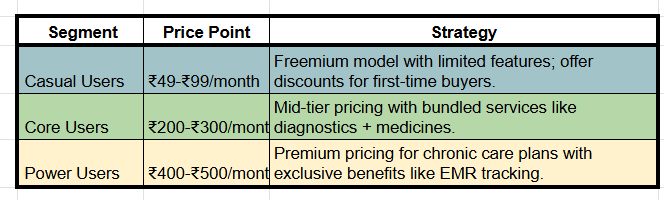
Why Monetize Champions and Loyal Customers?
- These segments have the highest price elasticity and lowest churn rates.
- They value convenience, reliability, and premium features, making them willing to pay more.
- Casual Users are more likely to churn if charged upfront, so a freemium model can help convert them gradually.
Example of Statistical Data Visualization
Here’s a breakdown of Apollo 24|7’s user base post-pricing introduction:
User Distribution by Segment:
- Champions (Power Users): 20% of total users
- Loyal Customers (Core Users): 40% of total users
- Casual Users: 40% of total users
Revenue Contribution:
- Champions: ₹400 x 2,000 = ₹8,00,000/month
- Loyal Customers: ₹250 x 4,000 = ₹10,00,000/month
- Casual Users: ₹75 x 1,500 = ₹1,12,500/month
Total Revenue Post-Pricing:
₹19,12,500/month (~₹2.29 crore/year)
Final Insights:
- Focus on monetizing Power and Core Users as they provide the highest revenue gain with minimal churn.
- Use freemium models or discounted trials to convert Casual Users gradually.
- Bundle complementary services like medicines + diagnostics for Core and Power Users to increase AOV.
- Leverage RFM analysis periodically to track user behavior changes and refine pricing strategies.
This approach ensures sustainable revenue growth while minimizing churn across all user segments!
The thumb rule is to monetize when Perceived Value > Perceived Price.
Here's how Apollo 24|7 can identify the right moment to charge users based on their journey:
Step 1: Identifying Value Drivers
- Money Saved: Discounts on medicines, free delivery, and bundled services (e.g., medicines + diagnostics).
- Time Saved: Doorstep delivery, virtual consultations, and quick diagnostics.
- Increased Efficiency: Chronic care plans with EMR tracking and reminders for recurring medications.
- Trust & Quality: Backed by Apollo Hospitals' reputation for reliable healthcare.
Step 2: Competitor Benchmarking
- Competitors like Practo and Netmeds offer similar services but lack Apollo's comprehensive ecosystem (medicine delivery + diagnostics + consultations).
- Apollo can charge a premium for its integrated offerings and accessibility in underserved Tier 2/3 cities.
Step 3: Quantifying Results
- Time Saved: On average, users save 2–3 hours per consultation or diagnostic test by avoiding physical visits.
- Money Saved: Circle Membership users save ₹500–₹1,000/month through free delivery and discounts.
Step 4: Map Perceived Value Across User Journey
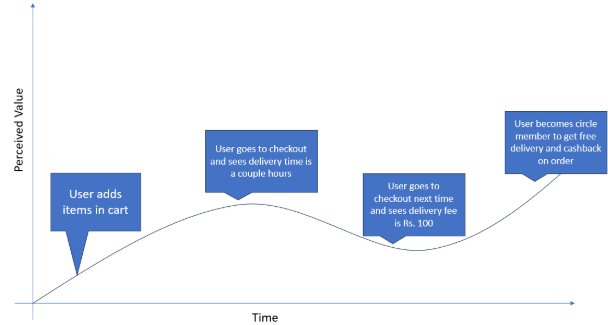
Perceived value is highest at,
- Checkout
- Post delivery
The user should be charged for delivery if they do not meet the criteria for free delivery. The user, based on their segment, should be asked to join the Circle membership program by showing them the value of the membership. The perceived value of the membership is much higher than the cost of the membership. This needs to be articulated well.
Lets take a look how the user journey looks like in an month as well
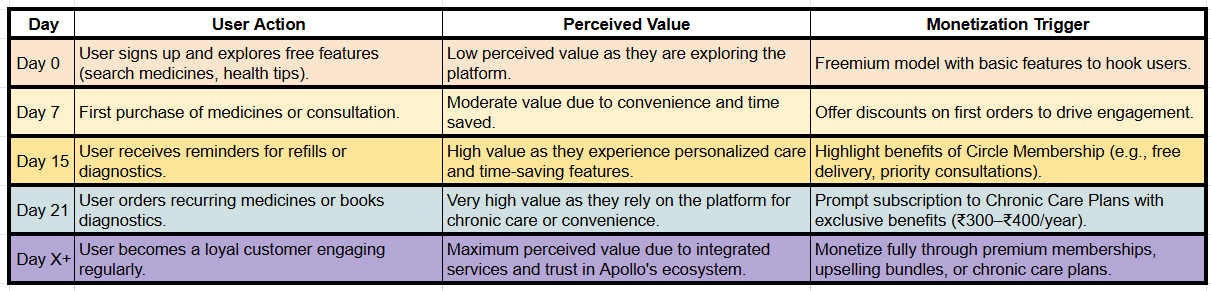
Final Insights:
- Charge users after they experience significant value (e.g., Day 15–21).
- Use freemium models early in the journey to hook Casual Users while upselling premium plans to Core and Power Users later.
- Position Apollo as an all-in-one healthcare solution offering unmatched convenience and trustworthiness.
This approach ensures users see enough value in Apollo 24|7 before committing to paid plans!
What to charge for?
(Identify what you're charging for- the core value and the currency for the product)
Apollo 24|7 can charge based on Time, Output, and Access, aligning with its core value proposition of convenience, trust, and comprehensive healthcare services. Here's how it is:
1. Time-Based Pricing
What to Charge For:
- Subscription plans like Circle Membership (monthly/yearly) that offer free delivery, discounts on medicines, and priority consultations.
- Example: ₹300/month or ₹3,000/year for premium membership.
Why It Works:
- Users save time through doorstep medicine delivery, virtual consultations, and diagnostic bookings.
- Comparable to Netflix’s model where users pay for uninterrupted access over time.
2. Output Based Pricing
What to Charge For:
- Pay-per-service model for consultations, diagnostics, or medicine orders.
- Example: ₹200–₹500 per consultation or ₹50–₹100 delivery fee for non-members.
Why It Works:
- Users pay only for the services they consume, similar to Urban Company’s approach.
- Encourages casual users to engage without committing to a subscription.
3. Access Based Pricing
What to Charge For:
- Access to Apollo’s healthcare ecosystem (e.g., chronic care plans or EMR tracking).
- Example: ₹400/year for exclusive chronic care benefits like reminders and free delivery.
Why It Works:
- Users pay for the right to access premium features regardless of usage frequency, similar to AWS’s pricing model.
4. Shareability-Based Pricing
What to Charge For:
- Family plans where multiple members can share a single subscription.
- Example: ₹500/month for a family plan covering up to 4 members.
Why It Works:
- Appeals to families managing healthcare collectively, increasing perceived value
How Apollo 247 Stands Out vs Substitutes

Positioning Apollo 24|7
Apollo should position itself as an all-in-one healthcare solution offering unmatched convenience and trustworthiness. The tagline could be: "Your Health Partner – Anytime, Anywhere."
Fun Note:
Think of Apollo 24|7 as your personal health genie—saving you time, money, and effort while delivering care right at your doorstep! Why wait in line when you can get it all in one app? 😊
Here are 2-3 pricing strategies for Apollo 24|7, to maximize revenue while considering perceived value and user behavior.
Strategy 1: Subscription-Based Pricing (Time-Based)
- Target Users: Core and Power Users
- Approach: Charge users a recurring fee for premium features like free delivery, discounts, and priority consultations.
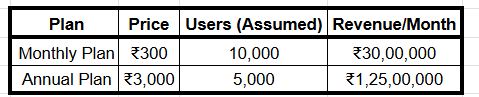
- Total Monthly Revenue: ₹1.55 crore
- Why It Works: Time-saving and cost-saving benefits align with perceived value for frequent users.
Strategy 2: Pay-Per-Service Pricing (Output-Based)
- Target Users: Casual Users
- Approach: Charge users per consultation, diagnostic test, or medicine order.

- Total Monthly Revenue: ₹1.6 crore
- Why It Works: Casual users pay only for what they consume, lowering churn risk while maximizing revenue from occasional usage.
Strategy 3: Outcome-Based Pricing (Access-Based)
- Target Users: Chronic Patients (Power Users)
- Approach: Charge based on health outcomes like improved chronic disease management.

- Total Annual Revenue: ₹6.25 crore
- Why It Works: Aligns pricing with tangible outcomes like better health management and medication adherence.
Key Insights:
- Subscription Plans (Strategy 1) are ideal for Core and Power Users due to their recurring needs.
- Pay-Per-Service (Strategy 2) caters to Casual Users who prefer flexibility and lower upfront costs.
- Outcome-Based Pricing (Strategy 3) appeals to highly engaged Power Users who value personalized chronic care solutions.
Pricing Page
Apollo 247 has a Circle membership pricing page.
Discovery In Web
- url : https://www.apollo247.com/
- Pricing page looks like:
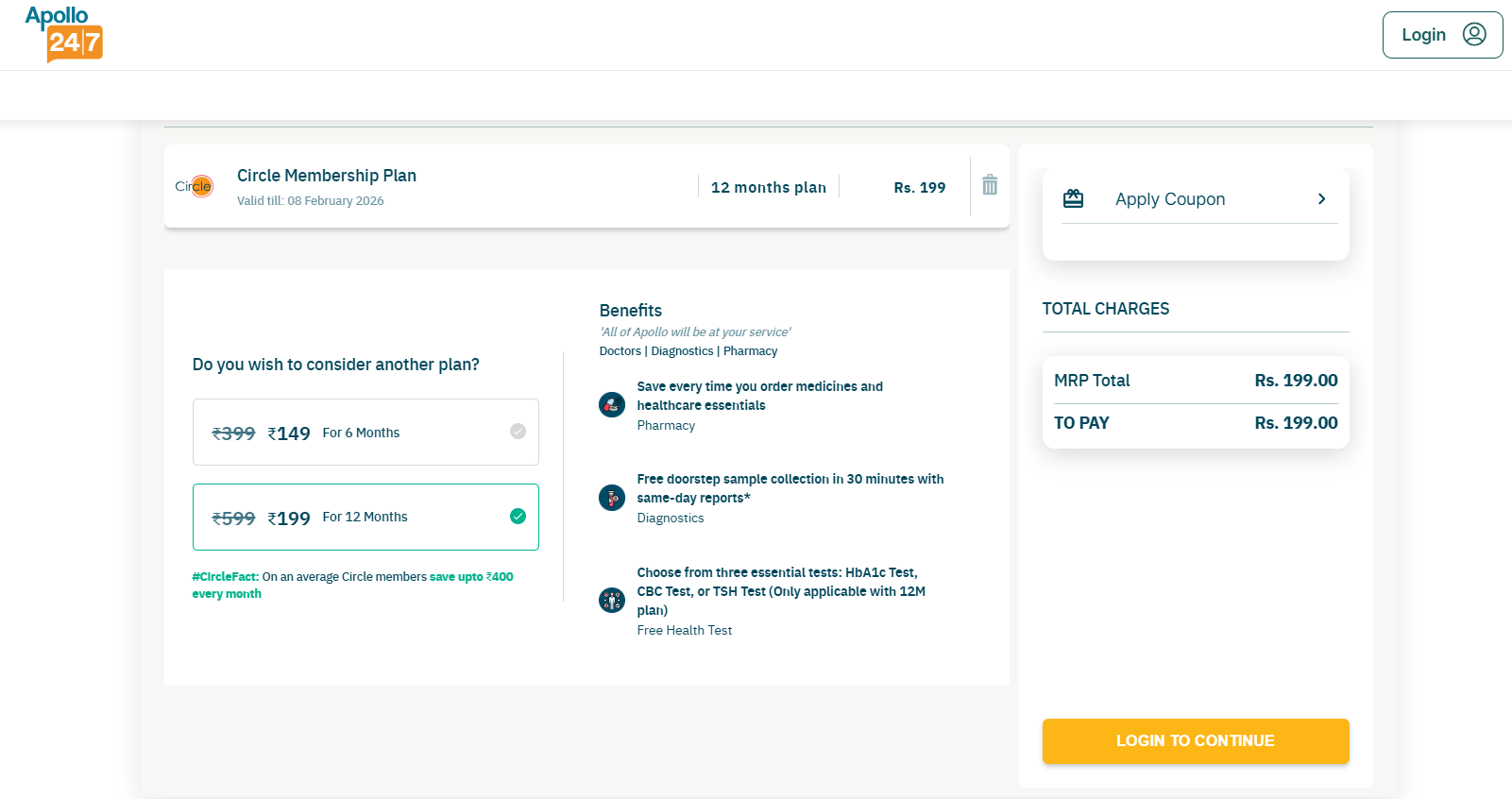
Analysis of Apollo 24|7 Pricing Page (Cognitive Biases)
Pros of Current Pricing Page (Based on Cognitive Biases)
- Anchoring Effect:
- The original price is shown as ₹399 and ₹599 but is slashed to ₹149 and ₹199, making the discounted price seem like a great deal.
- This leverages the anchoring bias, where users perceive the discounted price as more valuable compared to the original price.
- Scarcity Bias:
- The mention of "Save every time you order medicines" and exclusive benefits (e.g., free health tests) creates a sense of urgency and exclusivity, encouraging users to act quickly.
- Social Proof:
- The #CircleFact ("On average, Circle members save up to ₹400 every month") provides evidence of value, appealing to users' trust in others’ experiences.
- Simplified Choices:
- Only two plans are offered (6 months and 12 months), reducing decision fatigue and leveraging the paradox of choice (fewer options make decisions easier).
Cons of Current Pricing Page
- Lack of Default Option (Decoy Effect Missing):
- There’s no clear “default” plan highlighted as the most popular or best value, which could guide users toward a specific choice (e.g., the 12-month plan).
- A decoy plan (e.g., a higher-priced 3-month plan) could nudge users toward the more profitable 12-month plan.
- Insufficient Emphasis on Benefits:
- While benefits are listed, they are not visually emphasized or tied directly to user savings. This misses an opportunity to leverage the loss aversion bias, where users fear missing out on significant benefits.
- No Urgency Triggers:
- There’s no mention of limited-time offers or deadlines for discounts, which could activate the scarcity bias more effectively.
- No Personalization:
- The page does not tailor recommendations based on user behavior (e.g., frequent buyers vs. casual users). Personalization could increase perceived value for different user segments.
Suggestions for Redesigning the Pricing Page
1. Add a Default Plan with Decoy Effect
- Highlight the 12-month plan as the “Best Value” option with a visual badge like “Most Popular” or “Best Deal.”
- Introduce a decoy plan (e.g., ₹99 for 3 months) priced closer to the 6-month plan to make the 12-month plan more appealing by comparison.
2. Emphasize Benefits Visually
- Use icons and bold text to highlight key benefits for each plan:
- Example: “Save ₹400/month,” “Free Health Test Worth ₹500,” etc.
- Add a savings calculator showing how much users save annually with each plan.
3. Create Urgency
- Add time-sensitive messaging like:
- “Offer valid till February 15, 2025!”
- “Limited-time discount—Save 50% today!”
4. Incorporate Social Proof
- Include testimonials or stats like:
- “Join over 1 million satisfied Circle members!”
- “95% of members renew their subscription.”
5. Personalized Recommendations
- Use AI-driven prompts based on user behavior:
- Example: “As a frequent buyer, you’ll save ₹2,000/year with our 12-month plan!”
Proposed Design Layout
Section | Description |
|---|---|
Header | Add a tagline like “Your Health Partner – Save More, Stay Healthy!” . |
Plan Comparison Table | Clearly compare plans with features, savings, and badges like “Best Value.” |
Urgency Trigger | Add countdown timers or limited-time discount banners. |
Social Proof Section | Display testimonials or stats about existing Circle members’ satisfaction. |
Impact on revenue:
Assuming we implement these changes:
- Conversion rates for plans increase by:
- Monthly Plan: +10%
- Annual Plan: +20%
Plan | Price | Users (Post-Redesign) | Revenue/Month |
|---|---|---|---|
Monthly Plan | ₹149 | 12,000 | ₹17,88,000 |
Annual Plan | ₹199 | 7,000 | ₹11,61,667 |
Total Monthly Revenue Post-Redesign: ₹29,49,667 (~₹3.54 crore/year).
Discovery From mobile app:
Current pricing page in Mobile app looks like
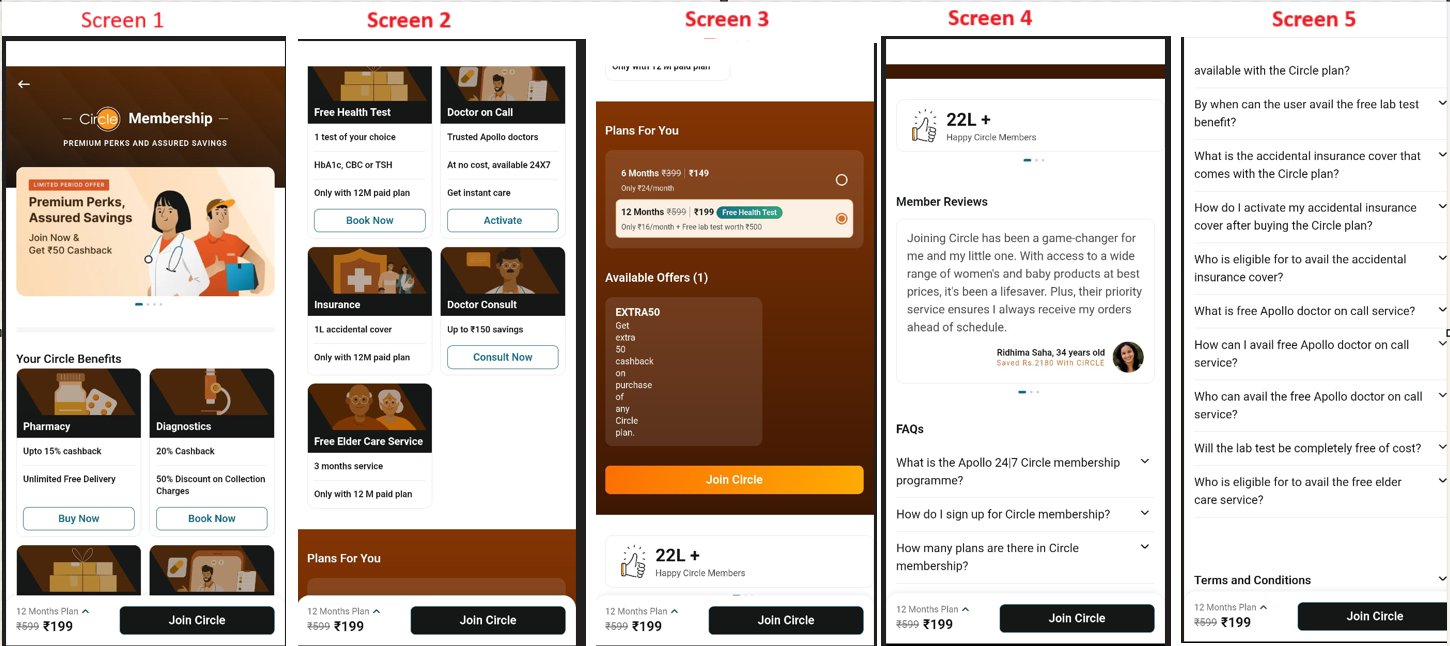
Analysis of Current Pricing Page (Cognitive Biases)
Pros:
- Anchoring Effect:
- The original price (₹399 and ₹599) is slashed to ₹149 and ₹199, making the discounted price seem like a great deal.
- This leverages the anchoring bias, where users perceive the discounted price as highly valuable.
- Simplified Choices:
- Only two plans (6 months and 12 months) reduce decision fatigue, leveraging the paradox of choice.
- Social Proof:
- Highlighting "22L+ Happy Circle Members" builds trust and appeals to users' reliance on others' experiences.
- Loss Aversion:
- Benefits like "Save ₹400 every month" and "Free health test worth ₹500" create a fear of missing out on savings.
- Visual Hierarchy:
- The pricing plans are visually separated, making it easier for users to compare options.
Cons:
- No Decoy Effect:
- There’s no intermediate plan to nudge users toward the higher-value 12-month plan. Adding a decoy option could make the 12-month plan appear more attractive.
- Insufficient Emphasis on Benefits:
- Benefits are listed but not visually emphasized or tied directly to user savings, missing an opportunity to highlight value clearly.
- Lack of Urgency Triggers:
- No time-sensitive offers or countdown timers are present to create urgency for immediate purchase.
- No Personalization:
- The same pricing is shown to all users, missing an opportunity to tailor recommendations based on user behavior (e.g., frequent buyers vs. casual users).
- Limited Call-to-Action (CTA) Appeal:
- The CTA “Join Circle” is generic and doesn’t emphasize urgency or benefits.
Suggestions for Redesigning the Pricing Page
1. Add a Decoy Plan
- Introduce a 3-month plan priced at ₹99 with limited benefits (e.g., no free delivery).
- This will nudge users toward the 12-month plan by making it appear more cost-effective in comparison.
2. Highlight the Most Popular Plan
- Add a badge like “Most Popular” or “Best Value” above the 12-month plan.
- Use contrasting colors (e.g., green or gold) to visually emphasize this option.
3. Emphasize Benefits Visually
- Use icons and bold text for key benefits like:
- 🛒 Save ₹400/month on medicines.
- 🩺 Free health test worth ₹500.
- 🚚 Unlimited free delivery.
4. Create Urgency
- Add a countdown timer or limited-time offer message, such as:
- “Offer valid till February 15, 2025!”
5. Personalize Recommendations
- Use AI-driven prompts based on user behavior:
- Example: “As a frequent buyer, you’ll save ₹2,000/year with our annual plan!”
6. Make CTAs More Engaging
- Replace “Join Circle” with action-oriented CTAs like:
- “Get Started Now – Save ₹400 Every Month!”
Proposed Pricing Page Layout
Section | Description |
|---|---|
Header | Add a tagline: “Your Health Partner – Save More, Stay Healthy!” |
Plan Comparison Table | Highlight the 12-month plan with badges and emphasize benefits visually. |
Urgency Trigger | Add countdown timers or banners for limited-time discounts. |
Social Proof Section | Display testimonials and stats about existing Circle members’ satisfaction. |
Impact is Maximizing Revenue
Assuming these changes increase conversion rates by 10%:
Plan | Price | Users (Post-Redesign) | Revenue/Month |
|---|---|---|---|
Monthly Plan | ₹149 | 12,000 | ₹17,88,000 |
Annual Plan | ₹199 | 7,000 | ₹11,61,667 |
Total Monthly Revenue Post-Redesign: ₹29,49,667 (~₹3.54 crore/year).
System 1 or System 2
Healthcare is a very sensitive segment. User needs to build and have trust in the system and make a well-educated purchase. This means that system 2 should be used. However, for the user to buy again, repeat orders of the same items, the trust is already built and this flow can be made through system 1.
The pricing page above depicts both plans that are available for the user to enroll themselves into the membership. Showing both plans at once gives the user a better idea on the plans and heir pricing in one screen without the need to scroll. The user can click on any one of the plans and checkout to enroll. The benefits are given above the pricing so that the user can easily see what they are getting and how much they have to pay for those benefits.
Brand focused courses
Great brands aren't built on clicks. They're built on trust. Craft narratives that resonate, campaigns that stand out, and brands that last.


All courses
Master every lever of growth — from acquisition to retention, data to events. Pick a course, go deep, and apply it to your business right away.





Courses
Built by Leaders From Amazon, CRED, Zepto, Hindustan Unilever, Flipkart, paytm & more






Crack a new job or a promotion with ELEVATE
Designed for mid-senior & leadership roles across growth, product, marketing, strategy & business




Learning Resources
Browse 500+ case studies, articles & resources the learning resources that you won't find on the internet.

Patience—you’re about to be impressed.